



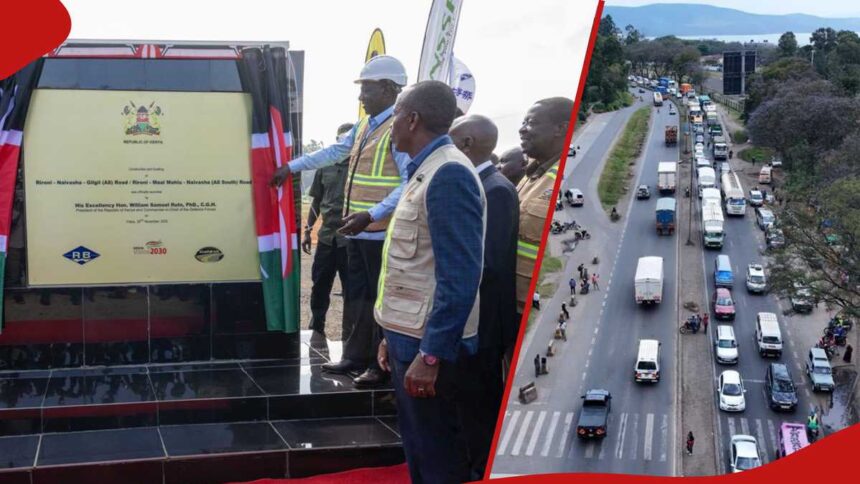
- A fresh court battle was launched over the plan to expand and toll the Rironi–Nakuru–Mau Summit Highway
- Motorists accused top government agencies of handing control of a major national corridor to private and foreign players
- The petitioners argued that motorists were already burdened by soaring fuel taxes and levies, yet the state still pushed for new toll charges
- They claimed the highway had been neglected for years, creating the ground for a disputed PPP model
Didacus Malowa, a journalist at TUKO.co.ke, brings over three years of experience covering politics and current affairs in Kenya.
A fresh legal fight is set to unfold over the planned expansion and tolling of the Rironi–Nakuru–Mau Summit Highway.

Source: UGC
This sets the stage for a major battle between motorists and President William Ruto’s Kenya Kwanza administration.
A group of road users moved to the High Court in Nakuru, accusing state agencies of ceding control of a key national transport corridor to private and foreign entities through long-term concession agreements.

Why are motorists against tolling Rironi–Nakuru–Mau Summit Highway
The Motorists Association of Kenya, joined by Peter Murima, Joyce Wamahiu, and Josphat Kamau, is challenging the Public-Private Partnership (PPP) model behind the A8 highway project.
They want the court to suspend all construction activities until the government justifies why a public road, funded over the years by taxpayers, should now come with an additional cost to motorists.
In their petition, they argue the planned toll of about KSh8 per kilometre is unfair, unnecessary, and unconstitutional.
Their core claim is simple: motorists are already paying for the road through various taxes, and tolling an existing public asset amounts to double taxation.
The petitioners list several levies, including the Road Maintenance Levy Fund (RMLF), which was increased in July 2024 from KSh18 to KSh25 per litre despite earlier assurances that it would not be touched.

They say the cumulative taxes on fuel now stand at nearly 90% of the landed cost, pushing motorists to the breaking point.
Yet, despite this burden, the government still intends to introduce toll booths along a highway that they argue should remain free.
In their filings, they state the A8 highway sits on public land and has long been built and maintained using taxpayer funds.
Concessioning it to private operators, they claim, alienates the common mwananchi from infrastructure they already own.
Why do petitioners see PPP or BOT models as problematic?
They further accused the government of intentionally underbudgeting and neglecting the Northern Corridor and other national highways for more than 16 years.
According to them, this pattern of neglect had created a false justification for bringing in private concessionaires under PPP or Build-Operate-Transfer (BOT) models.
Their lawyer, Jordan Kanga, said applying these models to an existing public highway is a form of privatisation disguised as modernisation.


Source: UGC
Kanga explained that placing a national corridor under private control compromises Kenya’s sovereignty, limits local capacity-building, and locks out Kenyan workers and companies from building and managing national infrastructure.
“Privatisation of national highways to foreign investors compromises national sovereignty and denies Kenyans the opportunity to build, learn, employ, and accumulate domestic capital,” Kanga stated.
The petition names the Cabinet Secretary for Roads, the Kenya National Highways Authority (KeNHA), the PPP Directorate, the China Road and Bridge Corporation (CRBC), the National Social Security Fund (NSSF), and the Attorney-General as respondents.

The petitioners want the court to compel the government to use taxes, sovereign loans, and funds from the RMLF to upgrade the highway instead of imposing toll charges.
They also claim that tolling only motorists, while the entire population benefits from national highways, amounts to unequal treatment and violates the right to freedom of movement.
The petitioners maintain that restricting access through toll gates on public land contravenes the Constitution, which declares that public land must remain accessible to all.
Ruto launches mega road project
The case was filed just hours after Ruto launched the expansion of the highway in Nakuru.
The project is estimated to cost between KSh170 billion and KSh200 billion and is being undertaken by two contractors, including CRBC, under a PPP arrangement.
Ruto said the upgrades will be completed by May 2027 and will ease congestion along the busy corridor connecting Nairobi to western Kenya.
Source: TUKO.co.ke