




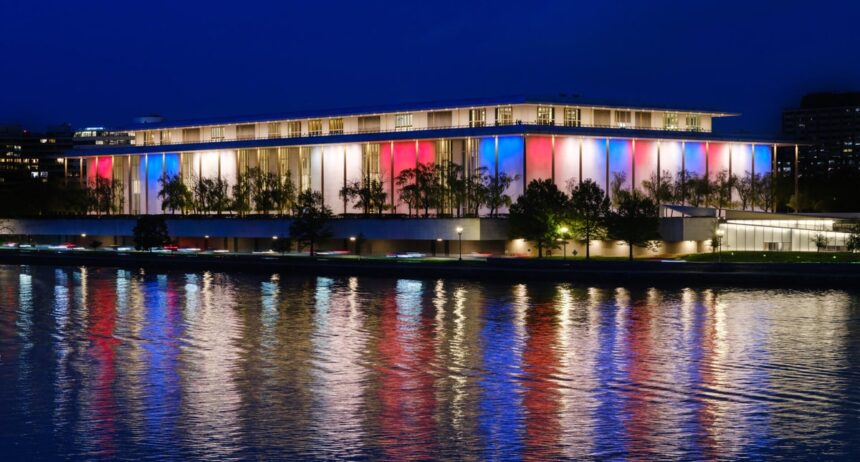
WASHINGTON — Inside the towering marble walls of the John F. Kennedy Memorial Center for the Performing Arts, beneath glimmering chandeliers, in the red-carpeted halls that will welcome soccer’s World Cup draw on Friday, theatergoers once felt sheltered.
Sheltered from politics. Sheltered by orchestra, opera and musicals. Sheltered by a cultural center that doubles as a “living monument” to a slain U.S. president, by a place that Larry Wilker, the Kennedy Center’s first full-time leader, calls “a sacred institution.”
They felt sheltered in part because the Center, for more than half a century, was apolitical. Built on the banks of the Potomac River in the nation’s capital, it opened in 1971 as an upscale place, but eventually evolved to welcome everyone. It hosted kids and adults, Republicans and Democrats, hip-hop heads and ballet dancers, people of all religions. At free performances in the grand foyer, outside the roped-off Concert Hall, “you had visitors [to D.C.], you had residents, people leaving work, homeless people,” Wilker tells The Athletic. “It was fantastic.”
It was a platform to “showcase the best of American arts,” Wilker says. And over the years, it welcomed millions of guests — for everything from jazz to Les Misérables to comedy. It became “a very accepted part of D.C. culture,” says Nathan Pugh, who frequented the Center as a child and later worked there. “To me,” says one longtime patron and Center volunteer who spoke to The Athletic before a recent concert, “it’s a cathedral.”
It was a “national treasure,” according to Hamilton producer Jeffrey Seller, and it was relatively uncontroversial — until this year, when U.S. President Donald Trump intervened.
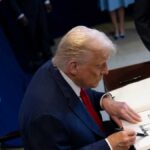
In February, Trump ousted 19 members of the Center’s previously bipartisan board of trustees and announced he would take over as chairman. He fired the Center’s president, Deborah Rutter, and installed an ally, former diplomat Ric Grenell, in Rutter’s place. Trump and Grenell both spoke about purging the Center of “woke” programming. Trump said he “didn’t like what they were showing.” He later joked about renaming it the “Trump Kennedy Center.” He seemed intent on remaking it in his image.
His takeover horrified many in the arts community. Some performers pulled out of gigs in protest. Some regular guests stayed away. Grenell has argued that “common-sense programming” will attract donors, but ticket sales have reportedly plummeted. Jane Raleigh, the dance director fired by Grenell in August, confirmed to The Athletic that sales had dipped and that subscription return rates “were down about 50% over where they should have been.”
“It’s tragic,” says Susanne Joyner, who’s been coming to National Symphony Orchestra concerts at the Center since the 1970s.
And it is, on the other hand, why the 2026 World Cup draw is here.

Inside the Concert Hall at the Kennedy Center, where FIFA will conduct the 2026 World Cup draw (Henry Bushnell / The Athletic)
FIFA, soccer’s global governing body, had been deep in discussions with multiple venues in Las Vegas; some officials preferred to hold the draw there, as FIFA had in 1993. Host city executives dreamed up plans to entertain potential sponsors in “Sin City.” The Trump administration, however, recommended the Kennedy Center, and FIFA president Gianni Infantino heeded the suggestion, multiple people familiar with discussions told The Athletic.
With less than four months to go, they agreed to a deal that will give FIFA exclusive use of the Concert Hall and other spaces for a $0.00 rental fee, per the leaked contract — but in exchange for a $2.4 million donation and “sponsorship opportunities” worth $5 million, Kennedy Center spokeswoman Roma Daravi has said.
That agreement, and its impact on other programming, also angered Kennedy Center devotees. Some led a small demonstration outside the building on Saturday, Nov. 22.
“It’s a cultural center, not a business center,” says a peeved Joyner, who told The Athletic that a show she hoped to attend had been moved to accommodate FIFA.
Now, though, it is evolving toward what Trump and Grenell want it to be. And on Friday, with Trump expected front and center, it will give the 2026 World Cup its first glitzy stage.
“The Kennedy Center,” Trump said in August, “will give it a phenomenal kickoff. And we’ll be involved.”

President Trump, flanked by Vice President JD Vance, FIFA president Gianni Infantino and Homeland Security Secretary Kristi Noem, announces the Kennedy Center will host the World Cup draw (Andrew Caballero-Reynolds / AFP / Getty Images)
A nonpartisan past
Over the decades since it first welcomed classical music connoisseurs, the Kennedy Center has, in fact, hosted plenty of non-performing arts events. All three former Center presidents, from Wilker in the 90s to Rutter from 2014-2025, spoke about opening the Center’s doors to a more diverse range of people and programming. Orchestra and opera remained cornerstones, but recently, the range included everything from a “COAL + ICE” climate exhibition to a United Arab Emirates National Day celebration, from a clothing exchange (combined with a cypher-style dance battle) to a 5K run.
What the Kennedy Center never did, though, was anything partisan, former executives and employees say.
U.S. presidents would appoint board members for six-year terms and indirectly influence the Center’s direction. Some would occasionally attend shows and even greet artists backstage. But to Wilker, whose tenure spanned the Republican presidency of George H. W. Bush and the Democratic presidency of Bill Clinton, their attendance never felt political. And at board level, he says, “we tried to be as bipartisan as we could. We worked very hard to talk to the president about making sure that we had representatives from both sides of the aisle.”
During Trump’s first four years in office, from 2017-2021, some individual artists spoke out against his policies and rhetoric. Trump and his family did not attend the Kennedy Center Honors, an annual awards gala that U.S. presidents had traditionally been present at. As an institution, though, the Center held its apolitical ground.
“While there were things that were different, the Kennedy Center functioned essentially normally under President Trump’s entire first term,” says Raleigh, who worked at the Center during the presidencies of Barack Obama, Trump and Joe Biden.

A bronze bust of former U.S. President John F. Kennedy inside the halls of the Kennedy Center in Washington, D.C. (Rahmat Gul / AP Photo)
During the buildup to the 2024 election, as with any election, Kennedy Center leadership explicitly reiterated the nonpartisanship, then-employees say. “They really emphasized to us: ‘Do not wear political T-shirts, do not wear political hats when you’re on the job,’” Pugh, a then-copywriter, says. “There was a sense of, ‘the Kennedy Center has never been a political organization, we’re not gonna start now. … We’ve never taken a political stance on anything.’”
For three months after Trump’s election, there was never a sense they would. Then, on the evening of Friday, Feb. 7, Trump posted on Truth Social: “At my direction, we are going to make the Kennedy Center in Washington D.C., GREAT AGAIN.
“I have decided to immediately terminate multiple individuals from the Board of Trustees, including the Chairman [David Rubenstein], who do not share our Vision for a Golden Age in Arts and Culture,” Trump wrote. “We will soon announce a new Board, with an amazing Chairman, DONALD J. TRUMP!”
The post, along with an Atlantic article detailing Trump’s planned takeover, blindsided employees. There had been communication between executives and the White House’s Office of Presidential Personnel about the process for appointing or replacing board members, according to multiple people familiar with the talks, but nothing about a full-blown takeover. “We have received no official communications from the White House regarding changes to our board of trustees,” the Center said in a statement that evening.
Biden-appointed board members, though, had begun receiving emailed termination notices. Two days later, en route to the Super Bowl, Trump admitted he’d never been to a show at the Center but said, citing reports from people who had been: “We don’t need woke at the Kennedy Center. Some of the shows were terrible, [it’s] a disgrace they were even put on.”
A day later, he announced that Grenell, a former U.S. ambassador to Germany with no experience in the arts, would be “interim executive director,” a position that hadn’t previously existed. “NO MORE DRAG SHOWS, OR OTHER ANTI-AMERICAN PROPAGANDA — ONLY THE BEST,” Trump wrote. “RIC, WELCOME TO SHOW BUSINESS!”

U.S. President Donald Trump is also the chairman of the Kennedy Center (Alex Brandon / AP Photo)
Drastic staff and leadership change
It’s unclear what Trump meant by “anti-American propaganda.” Drag, a centuries-old art form sometimes associated with queerness, was the main genre that he publicly targeted — even though it represented less than 1 percent of Kennedy Center programming.
More generally, Grenell has argued that “the left has taken over the Kennedy Center in the past. They’ve made it extremely political. Of course they cry when we try to bring it to the middle.”
Former Kennedy Center staffers, though, mostly dispute that notion.
“Artists tend to lean liberal,” Raleigh says, “but … we were frequently talking about making sure that the art we were presenting itself was never political in nature. Because we were meant to be a bipartisan and nonpartisan art center.”
So, many were shocked on Feb. 12 when an all-staff meeting was called, shortly after a virtual board meeting. The board, filled anew with Trump loyalists, had overwhelmingly voted to approve Trump as the new chairman. Next, they’d moved to fire Rutter and appoint Grenell. Soon after, Rutter stepped onstage at Studio K inside the REACH, a modern Kennedy Center addition, and told staff through tears that she was “leaving.”
Within hours, three other VPs had been fired. And from then on, “for many, many months,” Raleigh says, “we pretty much were finding out things that were happening inside the Kennedy Center either in the news or on social media — or directly from the people that they were happening to.”
Other former staffers confirm Raleigh’s account, citing a lack of all-staff emails or meetings. They communicated with one another via text, and occasionally, they’d notice security guards escorting colleagues from a manager’s office to their desk to gather belongings, then out of the building, after they’d been let go.
In March, the Center’s “social impact” team, which focused on outreach to underserved communities through arts and culture, was dismantled. Others, like Pugh, resigned because they no longer felt comfortable at work or aligned with Center leadership. Over the past year, according to two people who were fired, more than 100 staff — out of roughly 370 who were employed at the start of February — have departed. (Kennedy Center spokespeople did not respond to interview requests nor to questions about the staff turnover and other topics.)
Beyond the explicit targeting of drag, Raleigh and others say, there was not necessarily an instant overhaul of programming. The “common-sense” shows that Grenell has hailed, with a view toward attracting both donors and patrons, were already a significant part of the Kennedy Center’s rotation, according to former staffers. “It already was pretty mainstream,” Pugh says.
What changed was that some artists began questioning whether the Center had strayed from its ideals. Issa Rae, the award-winning actress, canceled a sold-out show due to the “infringement on the values of an institution that has faithfully celebrated artists of all backgrounds through all mediums.” Seller, the Hamilton producer, announced that the hit musical was canceling its March and April engagements because “our show simply cannot, in good conscience, participate and be a part of this new culture that is being imposed on the Kennedy Center.”
“In recent weeks we have sadly seen decades of Kennedy Center neutrality be destroyed,” Seller wrote in his March statement. “The recent purge by the Trump Administration of both professional staff and performing arts events at or originally produced by the Kennedy Center flies in the face of everything this national cultural center represents.”

Flags line the Hall of Nations at the Kennedy Center (Rahmat Gul / AP Photo)
‘It’s a very bizarre time’
Trump and Grenell have argued that the Kennedy Center, both physically and philosophically, needed “saving.” Trump in July secured $257 million in federal funding for renovations to the building, whose upkeep has always been government-funded. “Tremendous work is being done, and money being spent, on bringing it back to the absolute TOP LEVEL of luxury, glamour, and entertainment,” Trump wrote in August. Two months later, Grenell ordered the National Symphony Orchestra to dutifully play the U.S. national anthem prior to every performance.
They have also opened it up to, or used it for, a new type of programming — some of which is now being scrutinized by Democrats in the U.S. Senate. This fall alone, the Center hosted a vigil for conservative activist Charlie Kirk in September; the American Conservative Union Foundation’s “Christian Persecution Summit” in October; and a U.S.-Saudi Investment Forum the day after Saudi Crown Prince Mohammed bin Salman’s visit to the White House in November.
And now, it is largely in the hands of FIFA, which last week began a near-complete takeover of the Kennedy Center campus for the World Cup draw.
On Friday, thousands of soccer executives, dignitaries, journalists and others will step into the Center’s Hall of Nations or Hall of States, where Trump’s and Grenell’s names are now engraved on the marble wall. A couple thousand, the privileged ones, will file into the Concert Hall for pomp, politics, performances and then, finally, the picking of World Cup groups. Others will be sent to “overflow” seating in the Eisenhower Theater and elsewhere. Millions around the world will watch from afar. Infantino, a “close friend” of Trump, will preside — and present a new “FIFA Peace Prize” seemingly created for this occasion.
It will, in all likelihood, be the most-viewed global broadcast event that the Kennedy Center has ever hosted. It will bring a spotlight unlike any the venue has ever seen.
And, having displaced traditional shows, it will do nothing to placate the Center’s longtime patrons, like Joyner, who’ve expressed their disgust at the politicization of a “sacred” place.
“It’s a very bizarre time,” says the volunteer, who spoke on the condition of anonymity because she was not supposed to publicly discuss Kennedy Center politics. “I’ve never seen it like this.”