



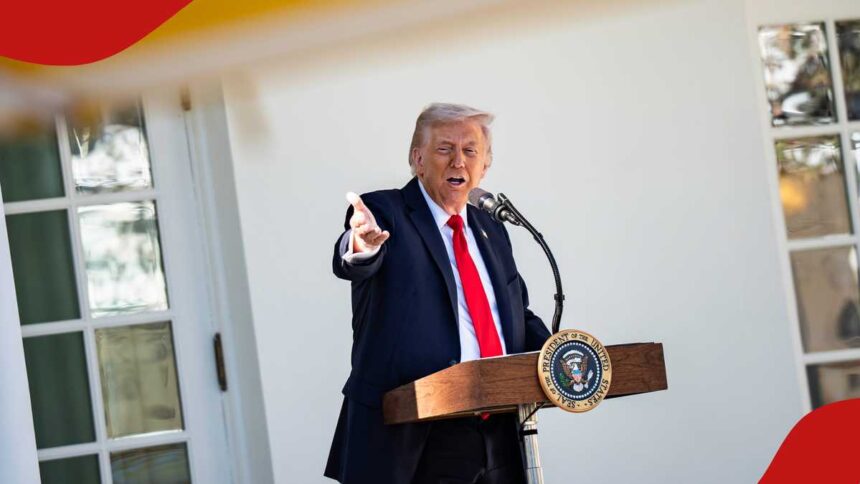
- The US president Donald Trump’s administration explained the move to suspend the green card lottery programme on Friday, December 19
- Homeland Security Secretary Kristi Noem issued a directive to the US Citizenship and Immigration Services Department
- The suspension of the green card lottery is President Trump’s most recent attempt to restrict immigration, noting that this would benefit Americans
TUKO.co.ke journalist Japhet Ruto has over eight years of experience in financial, business, and technology reporting, offering insights into Kenyan and global economic trends.
The United States (US) president Donald Trump’s administration has suspended the Diversity Immigrant Visa Programme, commonly referred to as the green card lottery.

Source: Facebook
Homeland Security Secretary Kristi Noem announced the decision on Friday, December 19, 2025, in a post on the X social media platform.
Why did Trump suspend the green card lottery?
Noem noted that she had ordered the US Citizenship and Immigration Services to pause the lottery until further notice.

She explained that the suspension came after a suspect identified as Claudio Manuel Neves Valente allegedly murdered a university professor at Brown University in Brooklyn.
Valente, a Portuguese national, entered the US after winning a green card lottery.
“The Brown University shooter, Claudio Manuel Neves Valente, entered the United States through the diversity lottery immigrant visa programme (DV1) in 2017 and was granted a green card. This heinous individual should never have been allowed in our country. In 2017, President Trump fought to end this programme, following the devastating NYC truck ramming by an ISIS terrorist, who entered under the DV1 programme, and murdered eight people. At President Trump’s direction, I am immediately directing USCIS to pause the DV1 program to ensure no more Americans are harmed by this disastrous programme,” Noem announced.
How is Trump limiting immigrants?
The suspension of the green card lottery is President Trump’s most recent attempt to restrict immigration, frequently in reaction to acts of violence that his government attributes to loose immigration laws.

Earlier, after an Afghan national was suspected of shooting two National Guard officers in Washington, the administration tightened restrictions on immigration from primarily poor countries.
Additionally, he imposed a $100,000 (KSh 12.9 million) application cost for H-1B visas, which are frequently used by the technology industry.

Source: Facebook
Along with strong immigration enforcement, the government is pursuing plans to significantly increase the capacity of immigration detention facilities, possibly utilising up to 20 warehouse “mega centres” nationwide.
Earlier, Trump’s administration suspended visa and asylum applications from 19 countries considered high risk.
Which countries did Trump impose travel restrictions?
In related news, the 47th US president upheld a stringent immigration policy to safeguard American citizens.
Trump’s new proclamation tightened and broadened restrictions on admission for citizens of countries with serious shortcomings in information-sharing, screening, and vetting deficiencies.
The countries include Syria in the Middle East, Burkina Faso, Niger, Mali and South Sudan.
Tanzanians and citizens of 14 other nations were subject to partial travel restrictions by the US during the same period.

According to US data, Tanzanians on B-1/B-2 visas have an overstay percentage of 8.30%, whilst those with F, M, and J visas have an overstay rate of 13.97%.
Source: TUKO.co.ke