





- Luhya elders have demanded that the late Cyrus Jirongo be buried with full cultural rituals, including an illuminated torch and porcupine quills, to expose those suspected of plotting his death
- Jirongo, a former Lugari MP, died in a road crash on December 13 along the Nairobi-Nakuru Highway, sparking speculation and allegations of foul play
- While the DCI continues to probe the accident, elders insist the rituals, fortified with ancient medicine, will haunt and compel conspirators to confess
Luhya elders insist the late Cyrus Jirongo ought to be buried with all the cultural rituals observed, arguing that his death can’t be dismissed like any other one.

Source: Facebook
The former Lugari MP perished in a nasty road crash on December 13 after his vehicle was crushed by a speeding Climax bus in Karai, along the Nairobi-Nakuru Highway.
His death sparks speculation, with those close to him alleging the death was plotted.

Cultural rituals pushed by Luhya elders in Jirongo’s send-off
Even as the Directorate of Criminal Investigations (DCI) continue its probe into the circumstances of the accident, the question of cultural practices has taken over the deceased politician’s send-off.
Luhya elders insist that Jirongo must be buried with an illuminated torch and four porcupine quills inside the coffin.
According to them, the torch will signify the haunting of those who might have schemed against Jirongo, and its going off will signify the conspirators are equally finished.
“The torch has a great significance. We will use batteries that will light the torch, and when it goes off, it will mean those involved in the death will be fading. And not only will we use the torch, but also the quills from the porcupine. They will be placed at all four corners of the grave to surveil those who were involved,” Harun Opanda, a Wanga elder, said in an interview with NTV.

Besides troubling the supposed conspirators, the ritual will expose them.
Amos Wawire, an elder from the Bunyala community in Kakamega’s Navakholo area, said the conspirators will not put up with the effects of the rituals, and that they will start coming out one after another to confess.
He revealed that for the torch ritual to work, it is reinforced by an ancient substance.
“If someone killed him, we will bury him with the torch; we will then fortify it with a special ancient medicine. We will pronounce it seven times, and the medicine will trace those involved. Shortly after, we will see them dying, and then they will come out to confess,” said Wawire.
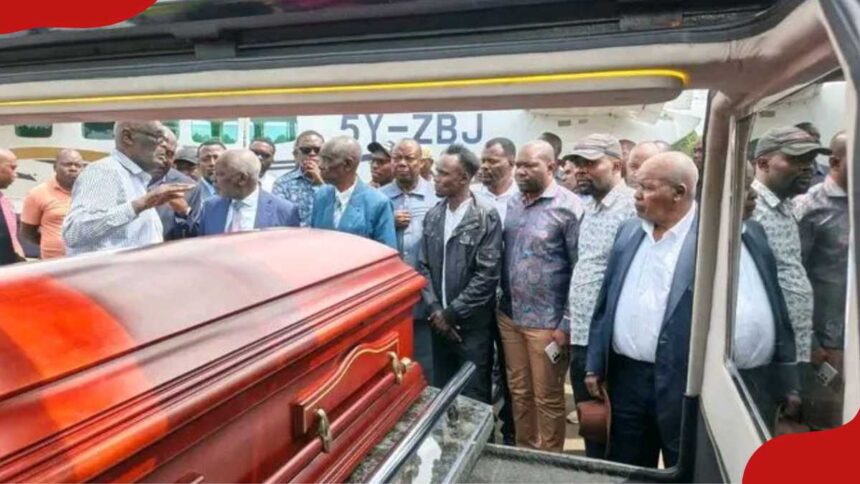
Elsewhere, a dramatic scene unfolded at the late Jirongo’s Maili Saba home late Sunday, December 28, moments after his body arrived from Nairobi.
Jirongo’s remains were flown from Nairobi to mark the beginning of his final journey.
At the Kitale Airstrip, elders disagreed over the cultural rites required to usher the body into his home.


Source: Facebook
Which rituals were proposed at Jirongo’s home?
Elders from Jirongo’s native Tiriki community, part of the larger Luhya community, insisted that his body should enter the home through the yard gate rather than the main one.
They maintained that this was necessary to fulfil cultural requirements, appease the ancestors, and prevent further misfortunes from striking the bereaved family.
However, former Westlands MP Fred Gumo, who chairs the funeral committee, opposed the ritual, arguing that Jirongo’s children were unfamiliar with such practices and that observing them would only unsettle the family as they mourned.
He recounted that at the airport, the elders had demanded the opening of a second gate and even threatened to leave if the body did not enter from the backyard.
Gumo explained that the committee could not yield to their demands, stressing that Jirongo was a man with his own home, children, and grandchildren, and that his body would enter through the main gate, be taken to the house, and allow the immediate family private time with him.

Why Gumo opposed Tiriki elders’ rituals
Gumo maintained that the rituals being pushed were outdated and risked tarnishing the distinguished image Jirongo held as a public figure.
He urged mourners to maintain order and warned against any disruptions to the funeral programme.
He explained that the Tiriki ritual was a practice from the past that was no longer observed, adding that Jirongo’s children were unfamiliar with it and would be confused if their father’s body was brought home through the backyard in the name of tradition.
Gumo further advised the family to resist attempts by individuals promoting such cultural practices, stressing that the send-off should be dignified.
Proofreading by Jackson Otukho, copy editor at TUKO.co.ke.
Source: TUKO.co.ke