



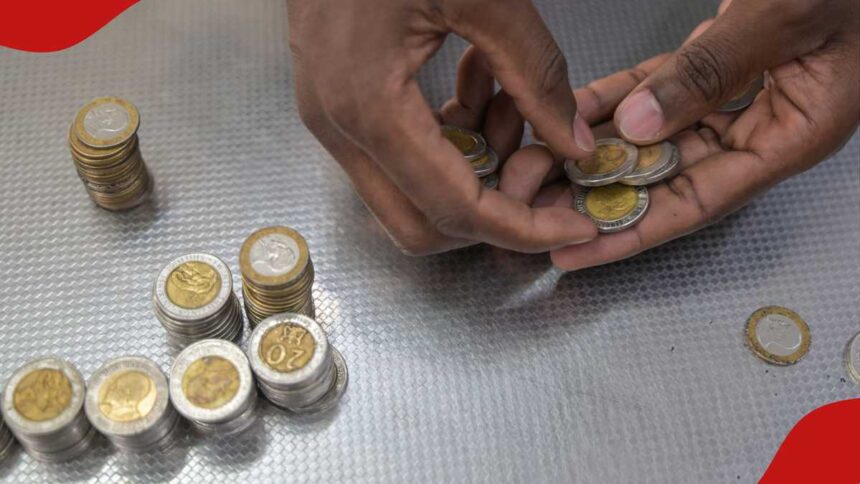
- The Central Bank of Kenya has invited bids for the purchase and supervised smelting of 281 tonnes of old and mutilated coins stored at its Mombasa, Nairobi, and Kisumu branches
- The disposal process is tightly controlled and open only to registered metal smelting or coin minting firms
- CBK staff, board members, committee members, and their immediate families explicitly barred from bidding
Elijah Ntongai, an editor at TUKO.co.ke, has over four years of financial, business, and technology research and reporting experience, providing insights into Kenyan, African, and global trends.
The Central Bank of Kenya (CBK) has invited bids for the purchase and smelting of 281 tonnes of old and mutilated coins.

Source: Getty Images
This is a highly regulated disposal process open only to registered metal and minting firms.
In a tender notice, the bank announced it is selling the unserviceable coins, stored across three branches, through an international open tendering method.

The entire consignment (Mombasa branch: 196,373 kg, Nairobi (Head Office): 76,347 kg and Kisumu branch: 8,947 kg) must be purchased and destroyed by the winning bidder under the strict supervision of CBK officials.
The tender, numbered CBK/015/2025-2026 and closing on January 22, 2026, outlines a meticulous process designed to ensure the complete and traceable destruction of the currency.
Who is eligible to bid for the coins?
The CBK has set strict eligibility criteria to prevent speculation or misuse of the currency.
According to the tender data sheet, bidding is exclusively open to firms registered and operating in the business of smelting metals or coin minting.
The tender explicitly bars CBK employees, board members, committee members, and their immediate families from participating.
All bidders must provide a valid Tax Compliance Certificate and proof of company registration. A key mandatory requirement is a written commitment that the CBK’s evaluation team will be invited to witness the start of the smelting or destruction process.

What are the conditions for the sale and destruction?
The sale is on an “As-Is, Where-Is” basis, meaning the bank offers no guarantees on the condition of the coins.
The winning bidder must pay a refundable tender security of USD 1,000 (or its equivalent in Kenyan Shillings) and will have between 14 and 21 days to pay the full balance after being awarded the contract.
Critically, the evaluation process is not based on price alone. Bidders will be technically evaluated on their experience, with up to 40 marks awarded for proof of having smelted at least 200 tonnes of material in the past year.
They must also provide evidence of owning smelting equipment and detail how quickly they can destroy the full consignment, with preference given to firms that can complete the work within four months.
Why is the CBK disposing of the coins?
The disposal of unfit currency is a standard central bank function to maintain the integrity and quality of money in circulation.

The tender requires the complete smelting or defacing of the coins, ensuring they cannot re-enter the financial system.
Interested firms can download the tender documents from the CBK or Public Procurement portal and must submit physical copies in sealed envelopes to the CBK Head Office on Haile Selassie Avenue by 10:30 am on the closing date.

Source: Facebook
CBK announces Treasury bonds results
In other news, CBK has raised KSh 60.58 billion in fresh borrowing after reopening two long-term Treasury bonds.
Investor demand exceeded the initial KSh 60 billion offer as bids worth KSh 71.54 billion were received, translating to an overall performance rate of 119.24%.
According to auction results, investor appetite was strongest for the 25-year bond (FXD1/2022/025), which attracted KSh 48.18 billion in bids, with CBK accepting KSh 40.34 billion at a weighted average yield of 13.7561%, while the 20-year bond (FXD1/2019/020) received KSh 23.36 billion in bids, of which KSh 20.24 billion was accepted at a weighted average yield of 13.2623%.
CBK, acting as the government’s fiscal agent, confirmed that the funds represent new borrowing that will be added to the national debt stock.
Source: TUKO.co.ke