



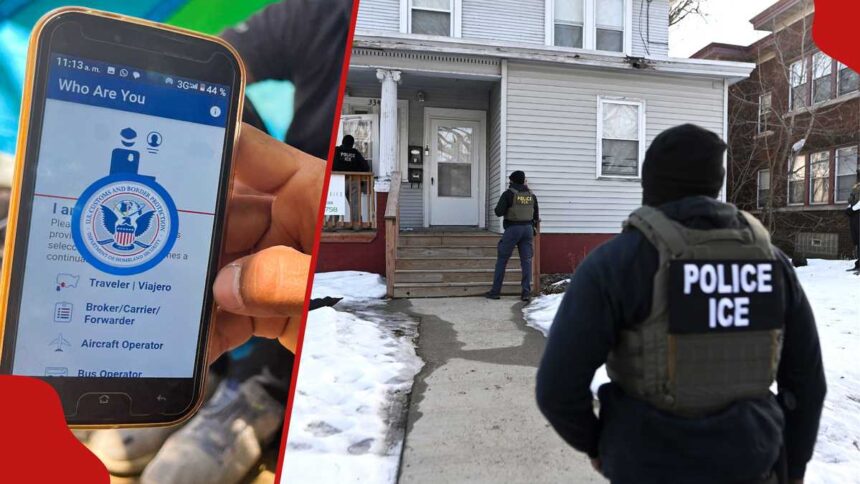
- The United States Department of Homeland Security (DHS) has more than doubled its financial incentive for migrants in the country illegally to leave voluntarily
- The increased “exit bonus” of $2,600 (approx. KSh 335,000) is offered through the updated CBP Home mobile app
- Homeland Security Secretary Kristi Noem announced the policy, stating that over 2.2 million people have voluntarily self-deported since January 2025
Search option is now available at TUKO! Feel free to search the content on topics/people you enjoy reading about in the top right corner 😉
Elijah Ntongai, an editor at TUKO.co.ke, has over four years of financial, business, and technology research and reporting experience, providing insights into Kenyan, African, and global trends.
The US Department of Homeland Security (DHS) is offering migrants without legal status a substantially larger cash reward to leave the country through official channels.

Source: Getty Images
In a policy update released on January 21, 2026, DHS announced that individuals who use the Customs and Border Protection (CBP) Home mobile app to arrange their departure will now receive a $2,600 stipend (approximately KSh 335,000).

This is a significant increase from the $1,000 (KSh 129,000) offered during the recent holiday campaign.
Search option is now available at TUKO! Feel free to search the content on topics/people you enjoy reading about in the top right corner 😉
The enhanced package also includes a government-paid flight home and full forgiveness of any civil fines for failing to depart the country previously.
The move is framed as both a “historic opportunity” for migrants and a cost-saving measure for US taxpayers, as the agency claims enforced deportations cost over $18,000 (KSh 2.3 million) per person.
What are the full incentives offered through the CBP Home app?
Apart from the guaranteed $2,600 “exit bonus” and fully paid travel arrangements to the home country or a country where the individual has lawful status, the individual will be forgiven for all civil fines for failing to depart under previous removal orders.
Once an application is submitted and vetted, non-criminal applicants are temporarily deprioritised for arrest or detention by Immigration and Customs Enforcement (ICE) before their scheduled departure.
Notably, participants will get to leave “as regular travellers, without arrest, detention, or restraints,” allowing them time to wrap up personal affairs.

How does the self-deportation application process work?
The DHS states the CBP Home app has been redesigned for ease of use. The process involves five key steps:
- Download the app from the Apple App Store or Google Play.
- Select a preferred language (the app is available in multiple languages, including Spanish and Haitian Creole).
- Fill out a simplified questionnaire and submit a current self-photo.
- Add additional family members if applicable.
- Submit the information to CBP Home for processing.

Source: UGC
Why did DHS increase self-deportation reward?
Secretary Kristi Noem presented the increased stipend as a celebratory measure for the one-year anniversary of the Trump administration’s return, but coupled it with a stark ultimatum.
“If you are here illegally, use the CBP Home App to take control of your departure and receive financial support to return home,” said Noem. “If you don’t, you will be subjected to fines, arrest, deportation and will never be allowed to return.”
The DHS release cites cost savings, noting that while an enforced deportation costs $18,245, a facilitated self-deportation with the new bonus costs about $5,100, saving of over $13,000 per person for American taxpayers.

The release also highlights the administration’s enforcement record, noting “over 675,000 deportations” in the past year.
The program’s details suggest it is aimed primarily at non-criminal individuals who are not in detention, offering them a “safe, orderly alternative” to avoid the trauma and consequences of arrest.
The move is likely to intensify debate around US immigration policy, with proponents viewing it as a pragmatic, humane, and fiscally responsible approach, while critics may argue it uses financial coercion and the threat of harsh enforcement to compel vulnerable people to abandon their lives in the US.

Source: Getty Images
Was a Kenyan priest deported from the US?
In December 2024, Kenyan Episcopal priest Rev James Eliud Ngahu Mwangi has opted for voluntary deportation to Kenya after nearly two months in detention at an ICE facility in Texas.
His detention followed a routine traffic stop in Huntsville, after which local police alerted immigration authorities.
Despite holding a valid work permit and lawful employment with the Texas Department of Criminal Justice, his immigration case stalled, leaving him confined with no clear timeline for release.

Mwangi said the prolonged detention felt like punishment, prompting him to choose dignity over continued incarceration.
His lawyer argued there was no justification for denying him bond and said the confinement caused significant emotional distress to him and his family.
The church said the experience was traumatic but noted that voluntary departure could preserve Mwangi’s chance to legally return to the US in future.
Source: TUKO.co.ke