



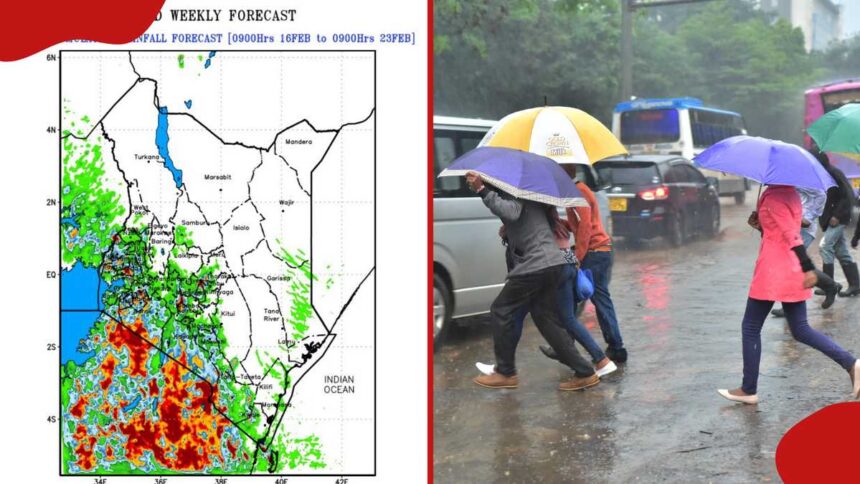
- On Monday, February 16, Kenya Meteorological Department forecasted ongoing heavy rainfall in five regions until February 23
- In the notice to Kenyans, Kenya Met projected that counties in northeastern Kenya will experience sunny and dry conditions
- During the same period, the weatherman projected that daytime temperatures above 30°C expected in several parts of the country
Amos Khaemba, a journalist at TUKO.co.ke, brings over four years of experience covering politics and current affairs in Kenya.
Nairobi – The Kenya Meteorological Department has issued the weekly weather advisory covering February 17 to 23.

Source: Getty Images
In a tweet on Monday, February 16, Kenya Met predicted that the ongoing rainfall in five regions is expected to continue for this week.
According to KMD, counties in Western Kenya, the Central Highlands, the Lake Victoria Basin, the Rift Valley and parts of the Southeastern lowlands will receive rainfall until February 23.
Search option is now available at TUKO! Feel free to search the content on topics/people you enjoy reading about in the top right corner 😉
Which counties will receive rainfall this week

However, counties in the northeastern and northwestern parts of Kenya will experience sunny and dry conditions during the week.
“This Week’s Weather Forecast | 17th–23rd February 2026. Rains are expected to continue over Western Kenya, the Central Highlands including Nairobi, the Lake Victoria Basin, the Rift Valley, and parts of the Southeastern Lowlands. In contrast, Northeastern and Northwestern Kenya are likely to experience generally sunny and dry conditions,” Kenya Met said.
Counties to receive rainfall are Nandi, Kakamega, Vihiga, Bungoma, Siaya, Busia, Baringo, Nakuru, Trans-Nzoia, Uasin-Gishu, Elgeyo-Marakwet, West Pokot, Kisii, Nyamira, Kericho, Bomet, Kisumu, Homabay, Migori and Narok.
Others are Nyandarua, Laikipia, Nyeri, Kirinyaga, Murang’a, Kiambu, Meru, Embu, Tharaka-Nithi, Nairobi, Machakos, Kitui, Makueni, Kajiado and Taita-Taveta Counties as well as the inland parts of Tana-River county.
Which counties will experience sunny and dry conditions
At the same time, the weatherman projected that daytime maximum temperatures above 30°C are expected in several parts of the country, including the Coast, the Southeastern Lowlands, and Northeastern and Northwestern Kenya.
Counties in this region are Turkana, Samburu, Marsabit, Mandera, Wajir, Garissa and Isiolo, Mombasa, Kilifi, Lamu and Kwale Counties, as well as the Tana Delta.

Read also
Kenya Power announces areas to experience electricity interruptions on Monday, February 16
However, minimum temperatures of below 10°C are expected in parts of the Central Highlands, the Central Rift Valley, and Western Kenya.
“Cool Nights: Nighttime (minimum) temperatures below 10°C are expected in parts of the Central Highlands, the Central Rift Valley, Western Kenya, and areas near Mt. Kilimanjaro,” the weatherman said.
Is El Niño making a comeback in 2026?

Source: UGC
TUKO.co.ke previously reported that fresh global climate forecasts showed a rapid shift in weather patterns, with a weak La Niña expected to fade and give way to a weak, possibly moderate to strong El Niño by mid 2026.
International weather centres, including the US Climate Prediction Center, projected that El Niño conditions could begin forming between May and July, a development often linked to heavier rainfall in Kenya.
Meteorological agencies in the United States and Australia also flagged rising chances of El Niño, although they cautioned that forecast reliability drops beyond May.
India’s Meteorological Department echoed the outlook, indicating a higher probability of El Niño during the June to July to August period, with clearer signals expected as the months progressed.
Source: TUKO.co.ke