




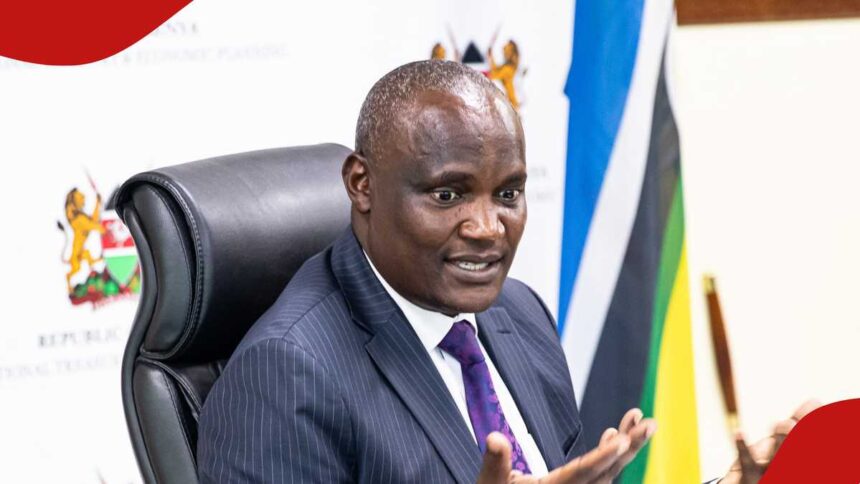
- National Treasury Cabinet Secretary (CS) John Mbadi announced that Kenya successfully priced a new Eurobond in two tranches
- The first tranche, which matures in 2034 and has an interest rate of 7.8%, will be repaid in three equal instalments
- The second tranche, which matures in 2039, will attract an 8.7% interest rate and will also be repaid in three equal instalments
TUKO.co.ke journalist Japhet Ruto has over eight years of experience in financial, business, and technology reporting, offering insights into Kenyan and global economic trends.
Kenya has returned to international markets and raised USD 2.25 billion (KSh 290 billion) to settle old debt and cover budgetary requirements.

Source: Twitter
The nation has successfully priced the new Eurobond in two tranches, according to the National Treasury.
What are the interest rates for the new Eurobond?
The first is USD 900 million (KSh 116 billion), which matures in 2034 and has an interest rate of 7.8%.

This initial tranche will have an average life of seven years because it will be repaid in three equal instalments between 2032 and 2034.
The second tranche, which matures in 2039, is worth USD 1.35 billion (KSh 174 billion) at an 8.7% interest rate.
With an average lifespan of 12 years, it will also be paid back in three equal instalments between 2037 and 2039.
“The government of Kenya is pleased to announce the successful pricing of a new dual-tranche Eurobond issuance totalling USD 2.25 billion,” Treasury Cabinet Secretary (CS) John Mbadi announced in a statement on Friday, February 20.
What does the new Eurobond mean for investors?
Terence Hove, a senior financial markets strategist at Exness, explained to TUKO.co.ke in an exclusive interview that the bond presents a relatively lower-risk USD-yielding asset compared to equities, corporate bonds, or other emerging-market instruments.
According to Hove, investors viewed Kenya as a “comeback story” after earlier debt distress, with strong demand from institutional buyers.

“Kenya returned to international markets by pricing in a new USD-denominated Eurobond in two tranches. As expected, investor interest surpassed supply, since the tranches pay 7.8% and 8% respectively at medium-term maturity. This seems like an interesting opportunity for long-term investors, offering a lower-risk alternative to other investment vehicles,” Hove explained.
“Kenya returns to international markets by pricing in a new USD-denominated Eurobond in two tranches. As expected, investor interest surpassed supply, since the tranches pay 7.8% and 8% respectively at medium-term maturity. This seems like an interesting opportunity for long-term investors, offering a lower-risk alternative to other investment vehicles,” says Terence Hove, Senior Financial Markets Strategist at Exness.
How will Kenya spend Eurobond proceeds?
The exchequer revealed that the investor demand was high, with orders surpassing the available supply.
“Existing public debt obligations will be refinanced using the proceeds, including the government’s tender offer to buy up to USD 350 million (KSh 45 billion) of the outstanding 8% notes due in May 2032 and up to USD 150 million (KSh 19.3 billion) of the remaining 7.250% notes due in February 2028,” the CS explained.
Mbadi said any remaining proceeds will support general budgetary needs.
The deal, according to the CS, is part of a broader strategy to spread out Kenya’s debt obligations over a longer time frame, lowering the possibility that huge sums will become due at once.


Source: Twitter
The successful offering came after a recent credit rating improvement by Moody’s, which noted higher external balances, stronger foreign exchange reserves, and a decreased default risk.
The international risk assessment firm said in a statement on Tuesday, January 27, 2026, that it has raised Kenya’s rating from Caa1 to B3.
It also reviewed the outlook from positive to stable.
What is Kenya’s debt?
According to the Central Bank of Kenya, Kenya’s debt has risen to KSh 12.25 trillion.
Kenya will look to the domestic market in the 2026/2027 fiscal year due to its mounting debt, with local sources expected to cover 82% of the budget deficit.
The budget deficit is estimated by Treasury to be KSh 1.1 trillion.
The Cabinet approved a KSh 4.7 trillion budget for the next financial year.
Source: TUKO.co.ke