



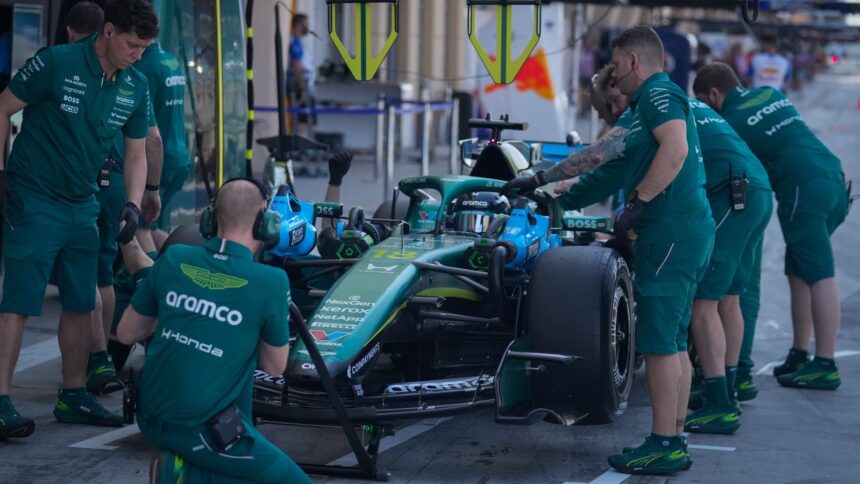
Having approached Formula 1’s major 2026 regulation change as the team that was most confident of breaking into the sport’s established elite, Aston Martin have endured a disastrous pre-season that has left their short to mid-term goals in apparent tatters.
Since Lawrence Stroll bought the team – then known as Force India – in 2018, the Canadian billionaire has spared no expense in attempting to establish another F1 superpower.
After rebranding the team as Aston Martin in 2021, a state-of-the-art facility was built and opened at Silverstone in 2023, before the team’s own wind-tunnel became ready for use in March 2025.
Some of the sport’s finest minds were also acquired to make use of the facilities, with legendary designer Adrian Newey coming on board in 2025 after former Mercedes engine guru Andy Cowell had joined the previous year.
The team also secured exclusive engine supply from Honda, who had powered Red Bull’s Max Verstappen to four successive titles from 2021-2024 and would have been retained by the Milton Keynes squad had they not signalled their intention to leave the sport before doing a U-turn.
Sky Sports’ Craig Slater and Nigel Chiu assess the Formula 1 pecking order following the final day of pre-season testing in Bahrain.
With a two-time world champion, Fernando Alonso, still driving at a high level alongside the owner’s son, Lance Stroll, all the pieces appeared to be in place for Aston Martin to ace the rules reset ahead of this season and threaten for race wins – and before long, titles.
Instead, last week in Bahrain at the last of three pre-season testing events, they appeared to be heading into the season-opening Australian Grand Prix, live on Sky Sports F1 from March 6-8, at the very back of the grid – so what has gone wrong?
Power unit pain
At the centre of Aston Martin’s woes appears to be the functionality of the Honda power unit they were so pleased to have secured exclusive use of.
For Alonso, in particular, there will be a hugely concerning sense of déjà vu, given the Spaniard was driving for McLaren in 2015 when their new deal to receive Honda engines went dreadfully.
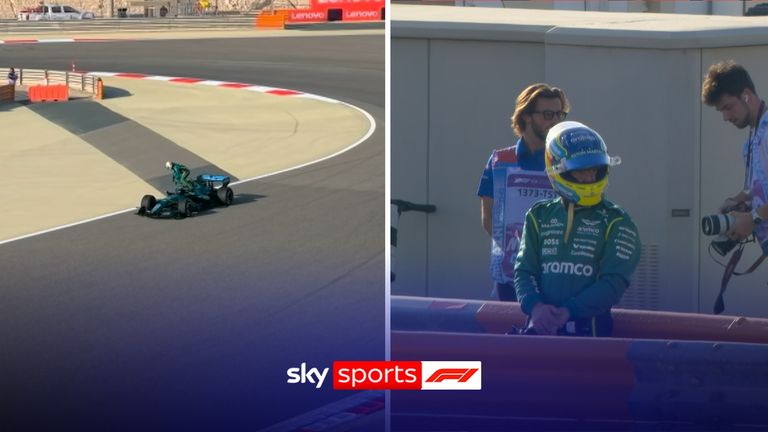
A red flag was issued during day two of the Bahrain Test after Fernando Alonso’s Aston Martin stopped on the track.
McLaren finished ninth, sixth and ninth in the Constructors’ Championship before ending the partnership after three years, with Alonso left so disillusioned that he would take two years out of the sport.
There are several elements that appear to have contributed to the Honda power unit’s disastrous start.
Firstly, Honda only maintained a skeleton F1 department from late 2021 amid their plans to leave the sport and didn’t re-establish a full workforce again until the deal with Aston Martin was agreed in early 2023.
Not only did that put them behind the four other engine manufacturers – Mercedes, Ferrari, Red Bull and Audi – who were already hard at work on their 2026 power units, but it also meant that the staff who had developed Verstappen’s title-winning engines was decimated.
Watch the highlights of the third day of the second Bahrain pre-season Test.
Then there is the double-edged sword of their exclusive deal with Honda, which means their lack of track time during the pre-season has the potential to be way more harmful than it would be for a team with a power unit used by several teams.
For example, Williams missed the Barcelona shakedown in late January but were able to benefit from the data provided by their engine supplier Mercedes, who also have McLaren and Alpine as customers.
A Newey adjustment period?
While history suggests Honda may have encountered some issues regardless of who was in charge of Aston Martin, it’s fair to question whether Newey’s approach has potentially exacerbated the problems in this case.
Newey is a legendary figure in F1, having designed cars that have won 12 constructors’ and 13 drivers’ titles, but he has taken on a different role at Aston Martin.
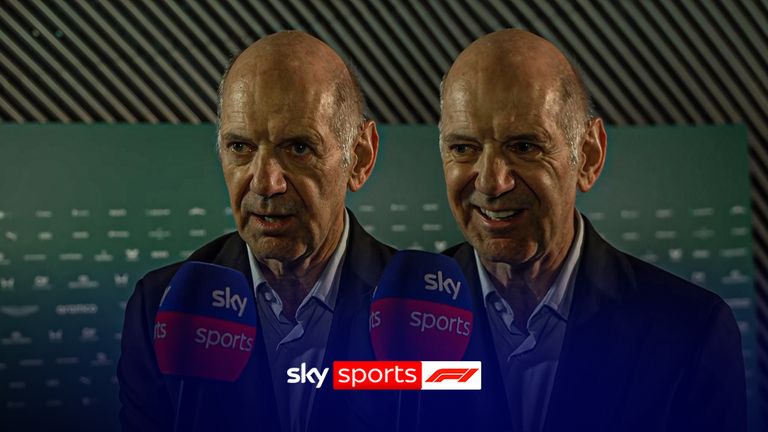
Adrian Newey admits Aston Martin’s delays to test in the wind tunnel could cost the team in the early stages of the 2026 season.
Having left Red Bull, Newey initially joined Aston Martin as managing technical partner in March 2025, but it was then announced in November that he would also be taking on the role of team principal.
While his first design for Aston Martin immediately caught the eye upon its late arrival in Barcelona, there are murmurs that elements of it may have added further challenges for Honda.
Furthermore, Newey has a reputation for pushing the design and development process as late as possible, which meant the car only got on track on the penultimate evening of the five-day event in Barcelona.
While it wouldn’t have changed everything, being ready earlier in the test would have provided Honda with more time to react and work on the inevitable issues they faced.
However, in Newey’s defence, his mindset is all about winning, and he no doubt would have been shocked and disappointed to discover an engine that is currently unable to efficiently support his design.
How quickly can they recover?
There is little doubt that Aston Martin’s meagre mileage in Bahrain, most notably on the final day of pre-season testing when they barely made it out of the garage, will have alarm bells ringing at Honda.
The question now is how long it will take them to catch up to the other power unit manufacturers, with work surely already under way on new iterations of the product.
The expectation is that they will bring a new and improved version as soon as possible, eliminating the fundamental issues that limited track time during the pre-season.
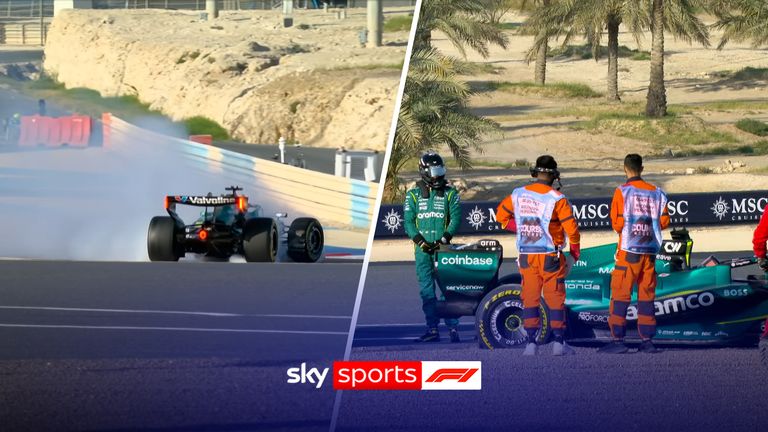
Lance Stroll spins off the track after a lock-up and brings out the red flag!
It’s difficult to predict how long that process will take, but the seriousness of the issues that have shown up would suggest it’s not necessarily going to be a quick fix.
Even once an improved engine is up and running, there is also going to be major learning required on how best to manage energy deployment, with the other manufacturers having already gathered huge amounts of data on this crucial performance element.
Given Honda were unable to get on top of their issues for three years during that dreaded McLaren partnership a decade ago, being ready to compete at the start of next season with a competitive engine would be a fine achievement from this point.
What could the consequences be?
F1’s ‘big four’ are going to remain in a league of their own for now. The team considered most likely to challenge have already stumbled, while McLaren, Mercedes, Red Bull and Ferrari all seem to have done a solid job with the new regulations.
Aston Martin themselves have given little away so far. Once it became clear how bad their situation was in the latter stages of the second Bahrain test, the media wasn’t given access to the two people they would most want to hear from – Newey and Alonso.
The pair will both be heard from in Melbourne and will surely put on a brave face, but how long that remains may depend on the speed of progress.
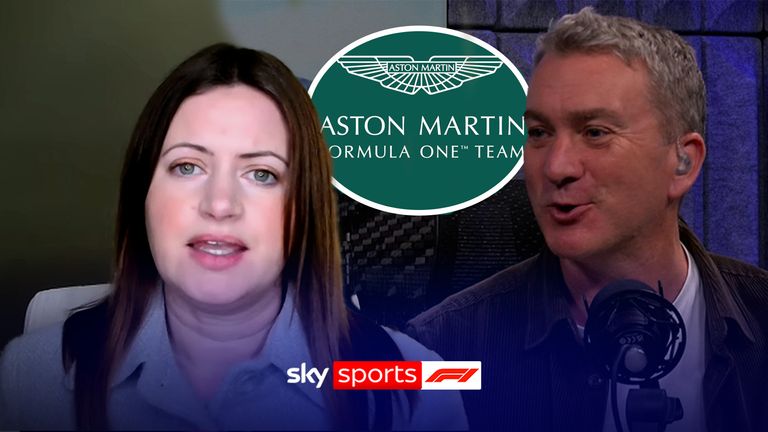
Sky Sports F1’s Bernie Collins and Craig Slater share their thoughts on why Aston Martin made a late arrival at the Barcelona shakedown in January.
Alonso, without a race win since 2013, has been waiting for an opportunity to compete at the front again, and spoke just weeks ago about his willingness to carry on in 2027 if he’s provided with a title-challenging car.
The events of the last few weeks have made that prospect less likely, and the frustration of potentially making up the numbers at the back of the field could lead Alonso, who turns 45 in July, to decide enough is enough.
Lawrence Stroll is not known for his patience and is unlikely to handle the potential embarrassment of the situation very well.
Whether he feels the need to make yet more personnel changes, or even decides taking Aston Martin to the top is mission impossible and considers cashing in on the sport’s boom, remains to be seen.
Watch every race of the 2026 Formula 1 season live on Sky Sports, starting with the Australian Grand Prix from March 6-8. Stream Sky Sports with NOW – no contract, cancel anytime